Apartment vs hotel in Melbourne CBD: which suits your trip?
Apartment vs hotel in Melbourne CBD: which suits your trip?
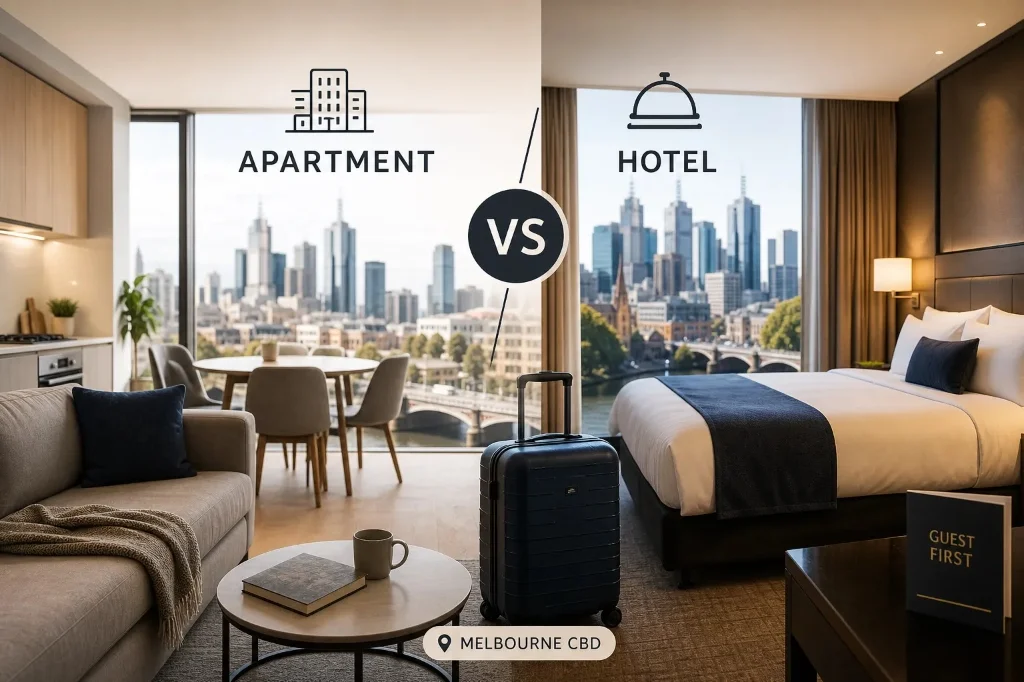
When weighing up an apartment vs hotel for your next Melbourne trip, the decision can look deceptively simple, until the details stack up. The room sleeps two. There's no kitchen. Laundry is $30 a load. And if you want four people in the same space, you're booking two rooms on different floors. What looked like a reasonable nightly rate doubles before you've even thought about dinner.
Hotels are familiar and comfortable, and for the right kind of trip they're genuinely the best option. But apartment-style accommodation in Melbourne's CBD has changed significantly. Properties like Havenly Escape at West Side Place now sit in a different category entirely: the space and self-sufficiency of a fully equipped apartment combined with resort-grade amenities and a prime city location. The apartment vs hotel question is no longer straightforward, and the answer depends almost entirely on how you're travelling.
This guide walks through five real differences between hotels and apartments, space, cost per head, kitchen and laundry access, amenities, and the scenarios where each one genuinely wins. By the end, you'll have a clear framework for deciding which suits your trip.
The difference between a hotel and an apartment, at a glance
| Hotel room | Serviced / short-stay apartment | |
|---|---|---|
| Space | One room for sleeping, bathing and relaxing | Separate bedrooms and a living area |
| Kitchen | Usually none, or a minibar | Kitchen for cooking your own meals |
| Laundry | Paid laundry service | Washer and dryer in the apartment (in many apartments) |
| Service | Reception, daily housekeeping, room service | Varies: some have a front desk, many are self check-in |
| Best for | Short stays of one to three nights, solo or couples | Families, groups and stays of four nights or more |
| Group of 6 or more | Several rooms, often on different floors | One apartment, everyone together |
In short: a hotel sells you a room and services; an apartment gives you a home base with space and a kitchen. The rest of this guide covers cost, space, laundry and when a hotel is still the better pick.
Our own apartments at West Side Place are a 2-bedroom (sleeps 6) and a 3-bedroom (sleeps 8).
Space: the difference a few square metres makes
What a standard Melbourne hotel room actually gives you
A standard room in a Melbourne CBD 4-star hotel typically measures between 30 and 38 square metres. There are beds, a compact bathroom, a small desk, and minimal storage. For one or two nights, that's perfectly functional. For anything longer, or for more than two guests, the limitations surface quickly. There's no shared living space, no dining area, and nowhere to decompress that isn't the same room where you sleep. For more detail on typical industry measurements, standard hotel room configurations show how space is allocated.
How apartment living changes the dynamic for groups and families
A 2-bedroom serviced apartment in Melbourne's CBD typically ranges from 70 to 90 square metres, roughly two to two-and-a-half times the size of a standard hotel room. That space translates into separate bedrooms, a distinct living area, a full dining space, and bathroom access that doesn't require anyone to queue. For a group of six or eight people, this stops being a comfort upgrade and becomes a logistical necessity. The alternative is three separate hotel rooms across different floors, which fragments the group and multiplies the cost.
The privacy factor that rarely gets discussed
In a hotel room, every activity competes for the same space. An apartment separates those activities across rooms. Parents can put children to bed while adults use the living room. Someone on a conference call doesn't have to whisper or leave the building. A teenager who sleeps late doesn't disrupt anyone else's morning. This kind of spatial privacy is generally far less available in standard hotel rooms, even interconnecting suites at the top end of the market don't replicate the natural separation of a purpose-built multi-bedroom apartment. It's simply a different type of accommodation.
Apartment vs hotel costs: when apartments genuinely start to win
The break-even point most travellers miss
The headline nightly rate on a serviced apartment often looks higher than a hotel room at first glance. The key is to factor in the cleaning fee and spread it across the number of nights. Once you do that, the break-even point for an apartment versus a comparable mid-range hotel typically falls around four to five nights. Beyond that, the apartment tends to be cheaper per night. For stays longer than 30 nights, the cost gap widens further as apartments typically offer weekly and monthly discount structures that hotels rarely match, though specific savings vary by property, so it's worth comparing directly. Industry analysis on the break-even point when an apartment becomes cheaper than a hotel is useful reading if you want to run the numbers yourself.
The per-person cost comparison for groups
This is where the apartment argument becomes particularly clear. A hotel charges per room, not per person. A group of six needs three separate rooms at roughly $200 each per night. That's $600 nightly, plus incidentals across three separate check-ins. One well-configured apartment sleeping the same group might cost $350 per night, a saving of $250 per night, or over $1,200 across a five-night stay, without anyone needing to compromise on where they sleep. (These figures are illustrative; actual Melbourne CBD rates vary by date and property, but the per-person maths consistently favours the apartment once you're travelling with more than two people.)
It's also worth noting that the long-stay apartment vs hotel comparison, and the broader Airbnb vs hotel vs serviced apartment question, often resolves in a similar direction: once you factor in group size, meal costs, and laundry, professionally managed apartments tend to come out ahead for stays of four nights or more. For detailed apartment specifications and floor plans, explore our 2-Bedroom Apartment (Sleeps 6) and 3-Bedroom Apartment (Sleeps 8) residences at West Side Place.
Kitchen and laundry access: the daily savings hotels don't advertise
What self-catering actually saves you per day
Without a kitchen, every meal becomes an expense. In Melbourne's CBD, eating out or ordering room service realistically costs between $120 and $150 per day for a family of four, even at mid-range restaurants. A full kitchen drops that to roughly $20 to $37 per day for the same family preparing meals at home. Across a five-night stay, the difference can offset a substantial portion of the accommodation cost itself. For families travelling with young children who have specific routines, the ability to cook also removes the stress of finding suitable restaurants at every sitting.
In-unit laundry versus hotel laundry: a cost that compounds
Hotel laundry services typically charge $20 to $40 per load. Over a week-long stay for a family, that adds up quickly, and guests still have to manage what to send out and when it returns. An in-unit washer and dryer in a serviced apartment brings that down to around $1 to $2 per load. It also means guests can pack lighter for longer trips, which matters for families, for business travellers on extended assignments, and for anyone who'd rather not arrive home with a suitcase full of unwashed clothes. For stays of two weeks or more, in-unit laundry alone represents a meaningful saving.
Amenities and service: why you shouldn't have to choose
What premium apartment accommodation offers that standard rentals don't
Not all short-term apartments are the same category of product. The difference between a basic listing on a rental platform and a professionally managed apartment in a purpose-built residential tower is considerable. At the premium end of Melbourne's CBD apartment market, guests access resort-style amenities, swimming pools, fully equipped gyms, and premium communal lounges, alongside the space and self-sufficiency of apartment living. This is a different proposition entirely from booking a spare room in a converted house.
Havenly Escape: where apartment living meets hotel-grade amenities
Havenly Escape at West Side Place on Spencer Street is a strong illustration of how these two worlds now overlap. The 2-bedroom and 3-bedroom apartments sleep up to six and eight guests respectively, with full kitchens, in-unit laundry, resort amenities, fast Wi-Fi, and dedicated workspaces. The building sits directly opposite Southern Cross Station, putting airport transfers, regional trains, and the CBD free tram zone within easy reach on foot. For groups, families, or extended-stay guests, this combination makes the apartment vs hotel comparison considerably more straightforward.
What hotels still do better on the service side
Honesty matters here. Daily housekeeping, room service, on-site breakfast, and 24-hour concierge are genuine hotel advantages that most apartments don't replicate as standard. Serviced apartments typically offer weekly cleaning rather than daily, and there's no breakfast buffet waiting downstairs. If these services matter to you, for a short corporate stay, a luxury weekend, or simply because you prefer not to manage anything yourself, a hotel delivers them consistently. These are real differences, not just marketing claims, and they're worth factoring into your decision.
When a hotel is genuinely the smarter pick
Short stays of one to three nights
For a single overnight, a solo business traveller, or a couple on a weekend away, the economics often don't favour an apartment. The cleaning fee is spread across fewer nights, and the per-person cost advantage largely disappears when there are only two of you. A well-located hotel with included breakfast, walkable access to meetings or attractions, and no cooking required makes strong practical sense for stays in this range. The flexibility of a hotel booking with free cancellation is also an advantage if your plans are uncertain. For a full breakdown of CBD stay options see our Melbourne CBD Accommodation guide.
When full-service hospitality is the point of the trip
Some trips are built around being looked after. A honeymoon, a milestone anniversary, or any stay built around effortlessness, daily turndown, a concierge who books your restaurant, room service at 10 pm, all of these are genuine hotel strengths. An apartment is designed for self-sufficiency and space, not for the kind of seamless, on-demand service that a premium hotel delivers. If the hospitality itself is the experience you're paying for, a hotel earns its rate.
How to decide which option suits your stay
The four questions worth asking before you book
Four questions will usually point you clearly in one direction. First, how many nights are you staying? If it's four or more, the apartment becomes competitive on cost. Second, how many people are travelling together? Once you're past two guests, the per-person maths shifts decisively toward an apartment.
Third, do you prefer to self-cater or eat out for every meal? Your answer affects the daily cost equation significantly. Fourth, do you need hotel-grade daily services, housekeeping, room service, a concierge, or are you comfortable managing independently? Answering these four questions honestly will resolve most of the uncertainty before you even open a booking platform.
Practical tips to get the best value from whichever you choose
If you're booking a hotel, choose a flex-rate with free cancellation, check whether breakfast is genuinely included or cheaper when added separately, and factor in daily parking before comparing rates. CBD hotel parking commonly runs $20 to $60 per day, which adds up across a week. If you're booking an apartment, calculate the cleaning fee into the total cost rather than the nightly rate, confirm Wi‑Fi speed if you're working remotely, and verify the actual sleeping configuration. A "3-bedroom apartment" that relies on a sofa bed for two guests is a different product from one with three separate bedrooms. Read the listing carefully before committing. For guidance on your rights and common cancellation policies when booking holiday accommodation, industry guidelines are useful to review before finalizing.
The decision comes down to what kind of stay you're planning
Neither hotels nor apartments win universally. Hotels are excellent for short stays, solo travellers, couples, and trips where full-service hospitality is the whole point. Apartments win convincingly for groups, families, stays of four nights or longer, and anyone who values space, self-sufficiency, and genuine cost savings across food, laundry, and per-person accommodation.
When you weigh up apartment vs hotel for a Melbourne CBD trip, the numbers rarely lie. For most stays involving more than two people or more than a few nights, the space, the kitchen, the laundry, and the per-head cost all point in the same direction. Havenly Escape at West Side Place represents what that option looks like at its best: apartment living with hotel-grade amenities in one of Melbourne's most connected locations.
If your next Melbourne trip fits that profile, it's worth looking at what a properly configured apartment can offer before defaulting to a hotel room out of habit. Run the numbers for your group size and length of stay, the right choice tends to become clear quickly. For broader reading and updates on Melbourne CBD accommodation, check our Melbourne CBD Accommodation Blog & Guides, and if you still have specific questions see our Melbourne CBD Apartment Accommodation FAQs.
Published By
Havenly Escape
Premium Melbourne CBD Short-Stay Accommodation
Havenly Escape offers premium, resort-style short-stay apartment accommodation in the heart of Melbourne CBD. Located directly opposite Southern Cross Station, we provide families, corporate travellers, and groups with a luxury home away from home, including access to world-class building amenities at West Side Place.
Ready to experience Havenly Escape?
Explore our luxury apartments at West Side Place in Melbourne CBD.